







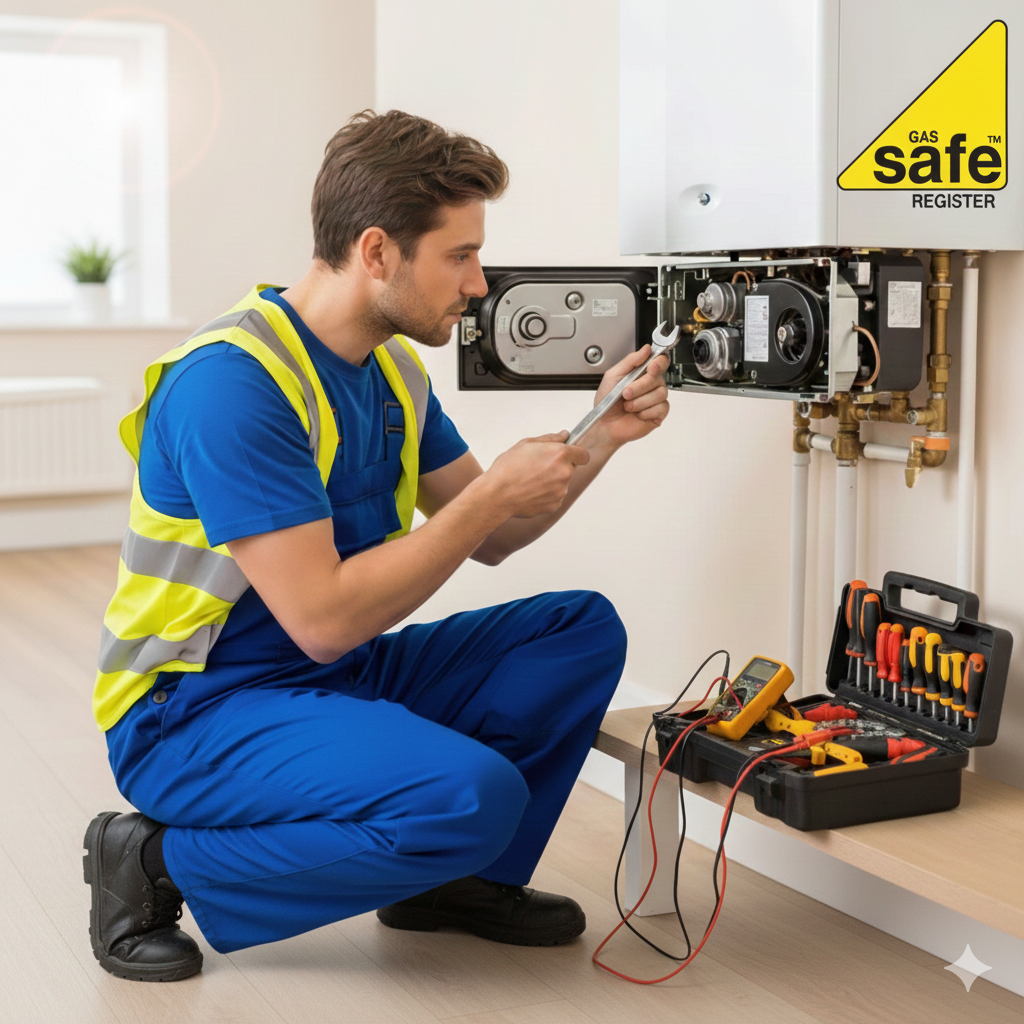
Before anyone touches your boiler, fire, or cooker, you need one thing confirmed: they are legally allowed to work on gas. The Gas Safe Register exists to prevent dangerous, unqualified gas work. This guide explains what Gas Safe is, how to check an engineer properly (in under a minute), and what paperwork you should receive after the job.
60-Second Gas Safe Check (Do This Every Time)
- Ask to see the Gas Safe ID card before work starts.
- Check the photo matches the person in front of you.
- Check the expiry date (it must be in date).
- Check the back of the card includes the right category for your job (for boilers, look for CENWAT or equivalent).
- Verify the licence number by searching the engineer or business on GasSafeRegister.co.uk or calling 0800 408 5500.
If they will not show a card, do not let them work on your gas.
In This Guide
- What is the Gas Safe Register?
- Why Gas Safe Matters
- How to Check an Engineer (Properly)
- Understanding the Gas Safe ID Card
- What Work Requires Gas Safe Registration?
- Requirements for Landlords
- Gas Safety Certificates and Paperwork Explained
- Dangers of Using Unregistered Workers
- How to Report Illegal Gas Work
- Frequently Asked Questions
What is the Gas Safe Register?
The Gas Safe Register is the official list of engineers and businesses that are legally allowed to carry out gas work in the UK (and certain Crown Dependencies). It replaced the old CORGI scheme in 2009.
Gas Safe operates on behalf of the Health and Safety Executive (HSE). Its job is simple: reduce unsafe gas work by ensuring only competent, qualified engineers are registered to work on gas appliances.
Why Gas Safe Matters
Gas work done badly is not a “small mistake”. It can create:
- Gas leaks: fire and explosion risk
- Carbon monoxide (CO): a poisonous gas you cannot see or smell
- Unsafe combustion: appliances that burn poorly and become dangerous over time
- Hidden faults: issues that only show up when the boiler is under winter load
If you want the blunt truth: using someone unregistered might save money today, but it can cost you your boiler, your insurance protection, and in worst cases, your life. If you want a full safety breakdown, read our carbon monoxide safety guide.
How to Check an Engineer (Properly)
There are three legitimate ways to verify Gas Safe status. Do at least two.
1) Check the ID card (always)
Every registered gas engineer should carry a Gas Safe ID card. Ask to see it before any work begins. A real engineer expects this question and will not be offended.
2) Verify online
Search the engineer or business on GasSafeRegister.co.uk. You can typically search by business name, registration number, phone number, engineer name, or ID number.
3) Call the helpline
You can also verify by phone: 0800 408 5500.
What if they refuse to show ID or cannot be verified?
- Do not let them start work
- Do not let them “just take a look” with the case off
- Book a verified Gas Safe engineer instead
If your boiler has failed and you need immediate guidance, use our boiler breakdown crisis guide to stay safe while you arrange a proper engineer.
Understanding the Gas Safe ID Card
The Gas Safe card is not just a logo. It contains information you should actually read.
Front of the card
- Photo: must match the engineer
- Name: the registered engineer
- Licence number: unique number you can verify
- Expiry date: must be in date
- Business/employer: who they work for
Back of the card (the most important bit)
The back lists what the engineer is qualified to work on. Being Gas Safe registered does not mean “qualified for everything”.
| Code | Meaning | Typically Covers |
|---|---|---|
| CCN1 | Core domestic gas safety | Fundamental gas safety competence |
| CENWAT | Central heating wet | Domestic boilers and wet central heating |
| CKR1 | Domestic cookers | Gas cookers and hobs |
| HTR1 | Gas fires | Domestic gas fires |
| MET1 | Meters | Gas meter work |
| LPG | LPG appliances | Liquefied Petroleum Gas work |
Rule: if the category for your appliance is not on the card, that engineer should not be doing that job.
What Work Requires Gas Safe Registration?
If it involves gas supply, combustion, flues, or the inside of a gas appliance, it requires a Gas Safe engineer. That includes:
- Boiler installation, replacement, servicing, and repair
- Gas pipework installation or alteration
- Gas cooker and hob installation
- Gas fire installation and servicing
- Flue work and flue checks
- Issuing landlord Gas Safety Records (CP12)
What you can do yourself (safe homeowner tasks)
- Replace thermostat batteries
- Check the boiler power supply and programmer settings
- Repressurise a sealed system using the filling loop (if you know how)
- Bleed radiators
- Thaw an external frozen condensate pipe (safely)
For step-by-step guidance during a failure, see our boiler breakdown guide.
Requirements for Landlords
Landlords have legal duties for gas safety. In practical terms, this means:
- Annual safety checks on gas appliances, flues, and relevant pipework
- A Gas Safety Record (CP12) issued after the check
- Provide the record to tenants (including new tenants before move-in)
- Keep records for at least 2 years
If you manage rentals, use our landlord boiler services page for the compliance workflow and booking.
Gas Safety Certificates and Paperwork Explained
Gas work is not “done” until the paperwork is done. Here is what you might receive and why it matters:
Gas Safety Record (CP12)
This is the landlord document issued after an annual gas safety check. It records what was checked, any defects, and whether appliances are safe.
Boiler service record
For homeowners, the service record is proof of maintenance, helps protect warranties, and supports resale if buyers ask for history. For servicing, see Boiler Servicing London.
Building Regulations notification (new boiler installs)
When a new boiler is installed, it typically must be notified for Building Regulations compliance. A competent installer can usually self-certify and you should receive confirmation afterwards.
Benchmark checklist (new boiler installs)
This is normally inside the boiler manual. It shows the boiler was commissioned correctly. Manufacturers commonly require it for warranty validity.
Dangers of Using Unregistered Workers
Unregistered gas work is one of the biggest avoidable risks in UK homes.
What can go wrong
- CO risk: unsafe combustion and poor flue setup
- Leaks: bad joints, incorrect pipe sizing, poor testing
- Insurance and warranty problems: lack of valid certificates and evidence of competent work
- Expensive rework: you often pay twice (once for the cowboy, once for the repair)
How to spot a problem operator
- No Gas Safe ID card
- “I’m CORGI” (outdated)
- Refuses verification
- Cash-only, no paperwork, no proper documentation
- Significantly cheaper than everyone else with vague scope
How to Report Illegal Gas Work
If you suspect illegal gas work, report it. You could prevent a serious incident in another home.
- Report concerns to Gas Safe Register: via GasSafeRegister.co.uk or by calling 0800 408 5500
- If you believe there is immediate danger: stop using the appliance and call the Gas Emergency number 0800 111 999
Frequently Asked Questions
Is CORGI still valid?
No. CORGI was replaced by the Gas Safe Register in 2009. If someone claims to be “CORGI registered”, treat that as a red flag and verify them properly.
Can a plumber work on my boiler?
Only if they are also Gas Safe registered and qualified for boiler work. Plumbing and Gas Safe are separate qualifications.
Do I need Gas Safe for electric boilers?
No. Electric boilers do not involve gas combustion and do not require Gas Safe registration. Electrical work should be carried out by a suitably qualified electrician.
Can I install my own boiler?
Only if you are Gas Safe registered and qualified for that work. Otherwise it is illegal and unsafe.
What if my landlord does not provide a gas safety record?
Landlords must provide a valid Gas Safety Record to tenants. If they refuse, raise it in writing and contact your local authority if needed.
How long is a gas safety record valid?
A landlord gas safety record is typically valid for 12 months from the date of the check, so renew it before it expires.
Can I sell a house with an old boiler that has not been serviced?
There is no homeowner legal requirement to service before selling, but buyers often ask for evidence of maintenance. Lack of history can become a negotiation point.
Need a Gas Safe Registered Engineer?
All our engineers are Gas Safe registered and qualified for domestic boiler work. We carry ID cards and encourage you to check our credentials before we start.
Verify Gas Safe registration: 0800 408 5500 or GasSafeRegister.co.uk